
Key takeaways
- Find the best night cameras for clear video after dark, with infrared and colour night vision, wide views and smart detection for home security outdoors.
What's inside
As an Amazon Associate I earn from qualifying purchases. This post may contain affiliate links at no extra cost to you.
The best night cameras are the ones that keep working when the light goes away. Most security incidents happen after dark, and a camera that records a bright, detailed picture at noon but a dark, grainy blur at midnight is not doing its job. Night performance depends on the sensor, the infrared illumination, the lens aperture and, on some models, a built-in spotlight that keeps the picture in colour.
There are two kinds of night vision. Infrared night vision uses invisible infrared light to illuminate the scene, producing a black-and-white picture that reaches far in total darkness. Colour night vision uses a spotlight or a large, sensitive sensor to keep the picture in colour, which makes clothing and vehicle colours visible. Infrared reaches further and works in complete darkness, while colour night vision gives more useful detail when there is some ambient light or a spotlight. The right choice depends on the place being watched.
This guide compares four verified cameras listed on Amazon US, chosen for night use: two wired PoE cameras with long infrared range, a pan-and-tilt camera with colour night vision and a solar panel, and a compact indoor camera with infrared night vision. Each one is described with the sensor, the night range and the detection features from its listing.
What to Look For
Sensor size and resolution. A larger sensor gathers more light, and a higher resolution keeps detail readable at distance. A 4K sensor shows faces and number plates far better than a 1080p sensor after dark.
Infrared range. Infrared range is measured in feet, and it decides how far into a garden or driveway the camera can see. A 100-foot range covers a whole yard, while a 30-foot range covers only a doorway.
Colour night vision. Colour night vision uses a spotlight or a sensitive sensor to keep colour after dark. It gives more useful detail than black-and-white infrared, but it needs a spotlight or some ambient light.
Lens aperture. A wide aperture, such as F1.6 or F1.8, lets more light reach the sensor. The aperture matters more at night than in daylight, when there is light to spare.
Spotlight. A built-in spotlight both lights the scene for colour video and acts as a visible deterrent. It also draws attention to the camera, which some owners want and others do not.
Detection. Person and vehicle detection reduce alerts from animals, branches and passing shadows. Smart detection matters more at night, when infrared can make harmless movement look dramatic.
Power. Wired PoE cameras record continuously all night, while battery and solar cameras wake on motion. Continuous recording catches more, but it needs a cable run or a charged battery.
Weather protection. An outdoor night camera faces rain, cold and dust. Check the weather protection stated on the listing, because a camera that fails in winter rain is no use at all.
Top Picks
Reolink RLC-810A 4K PoE Security Camera, 8MP, 100ft Infrared Night Vision, Person and Vehicle Detection

The Reolink RLC-810A is a 4K PoE security camera with an 8-megapixel sensor, 100 feet of infrared night vision, and person and vehicle detection built in. The 4K resolution is the headline for night use: fine detail such as faces and number plates stays readable at a distance where a 1080p camera would blur, and the infrared illumination reaches 100 feet, so a driveway, garden or yard stays covered after dark. Power over Ethernet carries both power and data through a single cable, which simplifies installation on a house wall or under an eave, because only one cable run is needed and there is no battery to charge or replace. Person and vehicle detection reduce unwanted alerts from swaying branches and passing animals, sending a notification only when a person or a vehicle is actually detected. The camera is weatherproof for outdoor mounting, records to a microSD card or to a Reolink recorder, and works with the Reolink app for live viewing and playback. Its fixed lens means the field of view cannot be changed after mounting, so the position needs to be chosen with care, and the PoE connection needs either a PoE switch or an injector. For a fixed outdoor spot where night detail and a wired, always-on connection matter, the RLC-810A is the strongest single camera in this group.
For long-range night detail, the RLC-810A is the strongest pick here: a 4K sensor, 100 feet of infrared night vision and person and vehicle detection over a single PoE cable.
Amcrest UltraHD 4K PoE Turret Camera IP8M-T2599EW, 8MP, 98ft Night Vision, 103-degree Wide Angle

The Amcrest UltraHD 4K PoE turret camera, model IP8M-T2599EW, records 4K video from an 8-megapixel sensor with night vision reaching 98 feet and a 103-degree wide-angle lens. The turret form is a practical choice for outdoor mounting: the ball-and-socket design aims easily in any direction and sits close to a wall or ceiling, which makes it harder to grab or knock out of alignment than a bullet camera on a long arm. The 4K sensor captures the detail needed to identify people and vehicles at a distance, and the infrared night vision keeps that detail available after dark out to nearly 100 feet. Power over Ethernet runs power and video over one cable, and the camera connects to an Amcrest recorder or to compatible third-party recorders using the ONVIF standard, which gives flexibility for a business that already has a recorder in place. The wide 103-degree angle covers a whole entrance, car park corner or shop floor from one mounting point. There is no built-in microphone or spotlight on this model, so two-way talk and colour night video need a different camera, and the fixed lens cannot zoom. For a business or a home that wants a discreet, well-aimed 4K PoE camera with long night range, the IP8M-T2599EW is a solid, professional pick.
For a discreet outdoor camera, the Amcrest turret is the solid choice: 4K video, 98 feet of night vision and a wide 103-degree view in a low-profile turret body.
Reolink Argus PT Ultra 4K Pan and Tilt Security Camera with Solar Panel, Dual-Band Wi-Fi, Colour Night Vision

The Reolink Argus PT Ultra is a 4K pan-and-tilt security camera sold in this listing with a solar panel, using dual-band Wi-Fi and colour night vision. The pan-and-tilt mechanism is what sets it apart from fixed cameras: the lens can sweep across a wide area and tilt up and down, following movement or covering a whole garden, yard or shopfront from a single mount. The 4K sensor keeps detail sharp at distance, and the built-in spotlight allows colour video at night instead of black-and-white infrared, which makes clothing and vehicle colours visible after dark. The solar panel in this listing keeps the rechargeable battery topped up from daylight, so the camera can sit on a fence, a shed or a far wall with no mains power and no cable run at all. Dual-band Wi-Fi connects on either the 2.4 or 5 gigahertz band, choosing the stronger signal, and the camera records to a microSD card for local storage. The solar panel needs direct sunlight for part of the day to keep the battery charged, so a fully shaded spot will still need manual charging, and heavy motion traffic shortens the time between charges. For a spot where wiring is impractical and a wide, moving view is needed after dark, the Argus PT Ultra is the most flexible camera here.
For colour video at night without wiring, the Argus PT Ultra is the flexible pick: a 4K pan-and-tilt camera with a spotlight for colour night vision and a solar panel for power.
Blink Mini, Compact Indoor Plug-In Smart Security Camera, 1080p HD Video, Night Vision, Motion Detection, Two-Way Audio, Works with Alexa, 3 Cameras (White)
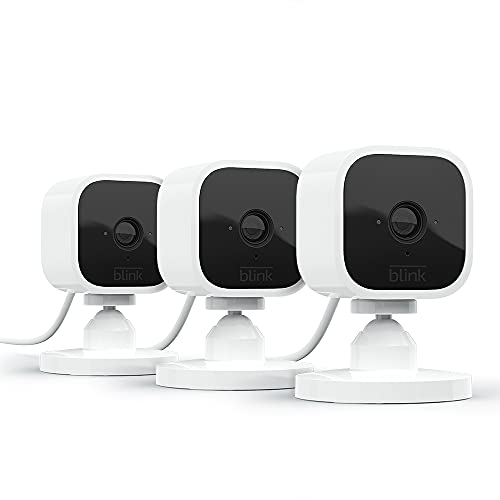
The Blink Mini is a compact indoor plug-in camera that records 1080p HD video with infrared night vision, motion detection and two-way audio, and this listing covers three cameras in white. At two inches by 1.9 inches and 1.7 ounces, the Mini is small enough to sit on a shelf, a desk or a windowsill without drawing attention, which is why it works well as a discreet indoor camera and as a pet camera. The 1080p video is sharp enough to recognise people and pets across a room, and the infrared night vision keeps the picture usable in a dark room. Motion detection sends an alert to the Blink app, and two-way audio lets the owner speak through the camera from anywhere. The 110-degree field of view covers a whole room corner from a single spot, and the camera works with Alexa for voice control and live view on a compatible screen. Because the Mini plugs into an outlet, it records without battery worries, but it needs an outlet nearby and a 2.4 gigahertz Wi-Fi network. Local storage needs a Blink Sync Module with a USB drive, and some smart features need a Blink subscription plan after the included trial. For a small, cheap, always-on indoor camera that can be placed in several rooms at once, this three-camera listing is the simplest way to start.
For indoor night watching, the Blink Mini is the simple pick: 1080p video with infrared night vision in a tiny plug-in body that can be placed in several rooms at once.
Comparison at a Glance
| Product | Sensor | Night vision | Power and extras |
|—|—|—|—||
| Reolink RLC-810A | 4K, 8MP | 100ft infrared | PoE, person and vehicle detection |
| Amcrest IP8M-T2599EW | 4K, 8MP | 98ft infrared | PoE, 103-degree view |
| Reolink Argus PT Ultra | 4K | Colour night vision, spotlight | Solar panel, pan and tilt |
| Blink Mini, 3-pack | 1080p | Infrared night vision | Plug-in, indoor, Alexa |
How to Place a Camera for the Best Night Picture
A night camera should be mounted between 7 and 10 feet high, looking slightly down at the area being watched. Too high, and faces become the tops of heads; too low, and the camera can be reached and moved. The camera should not face directly into a streetlight or a porch light, because the bright light will make the rest of the picture darker, and infrared light reflects off glass, so a camera behind a window will see its own reflection at night instead of the garden. If a camera must watch through glass, the infrared lights should be turned off and an outdoor light used instead. The area in front of the camera should be clear of branches and tall plants, because infrared light reflects off leaves and creates bright blobs that trigger motion alerts all night. Finally, the night range on a listing assumes total darkness with nothing in the way; a fence, a wall or a parked car shortens the useful range, so the camera should be tested after dark on the first night and moved if the picture is not clear.
It is also worth checking the recording settings for night. Continuous recording captures everything, while motion-only recording saves storage but can miss the first seconds of an event. A camera with a pre-event buffer records a few seconds before the motion trigger, which catches the approach as well as the event itself. Storage should be checked too: 4K video uses far more storage than 1080p, so a larger memory card or a recorder with enough capacity is needed for a camera that records all night.
Frequently Asked Questions
What is the best night camera for home security?
For outdoor use, the Reolink RLC-810A in this guide is the strongest pick: 4K video, 100 feet of infrared night vision and person and vehicle detection over a wired PoE connection.
Is colour night vision better than infrared?
Colour night vision gives more useful detail, such as clothing and vehicle colours, but it needs a spotlight or ambient light. Infrared works in total darkness and reaches further, so it suits a dark garden better.
How far can a night camera see in the dark?
It depends on the model. The cameras in this guide list infrared ranges from 98 to 100 feet, but the useful range is shorter when a fence, wall or car blocks the view.
Can a security camera see through a window at night?
Not well with infrared turned on, because the infrared light reflects off the glass. For a window view at night, the infrared should be turned off and an outdoor light used instead.
Do night cameras need a spotlight?
No. Infrared night vision works without any visible light. A spotlight adds colour night vision and acts as a deterrent, but it also draws attention to the camera.
Conclusion
The best night cameras keep detail visible after dark, and they do it in different ways. The Reolink RLC-810A and the Amcrest turret give long-range infrared detail over a wired connection, the Reolink Argus PT Ultra adds colour night vision with a solar panel where wiring is impractical, and the Blink Mini covers indoor rooms at night. Mount the camera at the right height, keep the view clear of branches and bright lights, and test the picture after dark on the first night.
Disclosure: As an Amazon Associate, stanthonyscalgary.com earns from qualifying purchases.
Related guides
More from Amazon
Programs that pair well with the guide above. Offers and eligibility are set by Amazon and may change.
Free shipping on eligible items, Prime Video and more. Eligible new members can start with a free trial.
Start a Prime free trialAudiobooks and podcasts to listen to on the go. Eligible new members can start with a free trial.
Try Audible freeAd-free music streaming. Eligible new subscribers can start with a free trial.
Try Music Unlimited freeA free business account with business pricing and bulk-buying tools for work, shop or home office.
Create a business accountAs an Amazon Associate we earn from qualifying purchases.
Write Your Review
No reviews yet. Be the first to share your experience!