
Key takeaways
- Compare the best poe security cameras for wired 4K coverage, with power and video over one cable, long night vision and multi-camera systems for business.
What's inside
As an Amazon Associate I earn from qualifying purchases. This post may contain affiliate links at no extra cost to you.
The best poe security cameras are the ones that stay on, stay connected and keep recording without batteries, charging or Wi-Fi dead spots. Power over Ethernet, known as PoE, carries power and video through a single network cable, so a camera needs only one cable run to a switch or a recorder. That single cable is the whole appeal: a wired camera records continuously, never runs out of battery, and does not depend on a wireless signal reaching the far corner of a property.
PoE suits fixed installations where the camera position will not change: a house wall, a shop entrance, a car park corner or a warehouse aisle. The trade-off is the installation itself. Each camera needs a cable run, and the cable must reach from the camera back to a PoE switch or a recorder with PoE ports. That takes planning, and for many buyers it takes professional help, but once the cable is in place, the camera needs no further attention beyond occasional cleaning of the lens.
This guide compares three verified PoE options listed on Amazon US: two single 4K PoE cameras and one four-camera PoE system. All three are the same type, wired PoE cameras, with no battery or Wi-Fi camera mixed in. Each one is described with the sensor, night range and connection details from its listing.
What to Look For
Resolution. A 4K sensor with 8 megapixels captures the detail needed to identify people and vehicles at a distance. A 1080p camera is cheaper, but it blurs the detail that matters most after an incident.
Night vision range. Infrared range decides how far the camera sees after dark. A range near 100 feet covers a driveway or a car park, while a shorter range covers only a doorway.
Field of view. A wide-angle lens covers a whole entrance or shop floor from one mounting point. Check the listed angle before ordering, because a narrow lens leaves blind spots at the edges.
PoE standard. Most PoE cameras use the standard 802.3af, which a PoE switch or recorder supplies. Check that the switch or recorder has enough PoE ports and enough power for all the cameras planned.
Weather protection. An outdoor PoE camera faces rain, cold and dust all year. The listing should state weather protection, and the cable connections should be protected from water.
Recorder compatibility. Some PoE cameras work only with the same brand recorder, while others support the ONVIF standard and work with third-party recorders. Check compatibility before ordering a camera for an existing system.
Detection. Person and vehicle detection reduce unwanted alerts from animals and moving branches. Smart detection matters more on a camera that records continuously, because the alert list would otherwise be endless.
Form factor. Bullet cameras stand out from a wall, dome cameras sit flatter, and turret cameras aim easily in any direction. The form should suit the mounting point and the risk of tampering.
Top Picks
Reolink RLC-810A 4K PoE Security Camera, 8MP, 100ft Infrared Night Vision, Person and Vehicle Detection

The Reolink RLC-810A is a 4K PoE security camera with an 8-megapixel sensor, 100 feet of infrared night vision, and person and vehicle detection built in. The 4K resolution is the headline for night use: fine detail such as faces and number plates stays readable at a distance where a 1080p camera would blur, and the infrared illumination reaches 100 feet, so a driveway, garden or yard stays covered after dark. Power over Ethernet carries both power and data through a single cable, which simplifies installation on a house wall or under an eave, because only one cable run is needed and there is no battery to charge or replace. Person and vehicle detection reduce unwanted alerts from swaying branches and passing animals, sending a notification only when a person or a vehicle is actually detected. The camera is weatherproof for outdoor mounting, records to a microSD card or to a Reolink recorder, and works with the Reolink app for live viewing and playback. Its fixed lens means the field of view cannot be changed after mounting, so the position needs to be chosen with care, and the PoE connection needs either a PoE switch or an injector. For a fixed outdoor spot where night detail and a wired, always-on connection matter, the RLC-810A is the strongest single camera in this group.
For a single wired camera, the RLC-810A is the strongest pick here: 4K video, 100 feet of infrared night vision and person and vehicle detection over one PoE cable.
Amcrest UltraHD 4K PoE Turret Camera IP8M-T2599EW, 8MP, 98ft Night Vision, 103-degree Wide Angle

The Amcrest UltraHD 4K PoE turret camera, model IP8M-T2599EW, records 4K video from an 8-megapixel sensor with night vision reaching 98 feet and a 103-degree wide-angle lens. The turret form is a practical choice for outdoor mounting: the ball-and-socket design aims easily in any direction and sits close to a wall or ceiling, which makes it harder to grab or knock out of alignment than a bullet camera on a long arm. The 4K sensor captures the detail needed to identify people and vehicles at a distance, and the infrared night vision keeps that detail available after dark out to nearly 100 feet. Power over Ethernet runs power and video over one cable, and the camera connects to an Amcrest recorder or to compatible third-party recorders using the ONVIF standard, which gives flexibility for a business that already has a recorder in place. The wide 103-degree angle covers a whole entrance, car park corner or shop floor from one mounting point. There is no built-in microphone or spotlight on this model, so two-way talk and colour night video need a different camera, and the fixed lens cannot zoom. For a business or a home that wants a discreet, well-aimed 4K PoE camera with long night range, the IP8M-T2599EW is a solid, professional pick.
For a discreet wired camera, the Amcrest turret is the solid choice: a 4K sensor, 98 feet of night vision and a low-profile turret body that aims easily and resists tampering.
Amcrest 4-Camera PoE Security Camera System, UltraHD 4K, Night Vision, Wired Outdoor Cameras
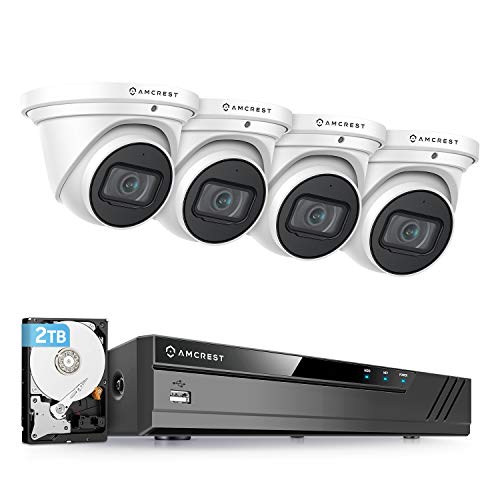
The Amcrest four-camera PoE security camera system covers a property with four wired UltraHD 4K cameras, each with infrared night vision, connected through Power over Ethernet. A multi-camera system is a different purchase from a single camera: instead of covering one door or one corner, four cameras cover a front entrance, a back garden, a driveway and a side passage at the same time, with all four feeds viewable together from one app or monitor. The 4K sensors give the detail needed to identify people and vehicles across a car park or a shop floor, and the infrared night vision keeps each camera working after dark. Power over Ethernet means each camera needs only one cable run for power and video, which keeps the installation tidier than separate power and video cables, although running four cables still takes planning and, for many buyers, professional help. The wired design means no batteries to charge and no Wi-Fi dead spots, and the cameras record continuously rather than waking only on motion. The trade-off is the installation effort: cable runs, mounting points and a recorder location all need to be planned before ordering, and the system is best suited to a property where the camera positions are fixed for the long term. For a small business or a larger home that needs whole-property coverage in one purchase, this four-camera system is the most complete option in this group.
For whole-property coverage, the four-camera Amcrest system is the complete option: four wired 4K cameras with infrared night vision, covering four areas from one system.
Comparison at a Glance
| Product | Sensor | Night vision | System |
|—|—|—|—||
| Reolink RLC-810A | 4K, 8MP | 100ft infrared | Single camera, PoE |
| Amcrest IP8M-T2599EW | 4K, 8MP | 98ft infrared | Single turret camera, PoE |
| Amcrest 4-camera system | 4K | Infrared night vision | Four cameras, PoE system |
Planning a PoE Camera Installation
A PoE installation starts with a plan, not a purchase. Walk the property and mark each camera position, then trace the cable route from each camera back to the switch or recorder. The cable run should avoid power cables where possible, because running network cable alongside mains power can cause interference, and the cable should be protected where it passes through walls or along the outside of a building. Outdoor-rated cable is needed for any run that leaves the building, and the connections at the camera should be sealed against rain. The total cable length for one run should stay within the network limit, and the PoE switch must have one port per camera plus a port for the recorder or the network. A switch with more ports than currently needed leaves room for a camera added later without replacing the switch.
Before fixing anything permanently, each camera should be connected on a bench and checked: the picture, the night vision, the detection alerts and the recording should all work before the camera goes up a ladder. The camera position should then be tested with a temporary mount, because moving a camera after the cable is run is far more work than moving it before. The lens should be cleaned after installation, since fingerprints and dust from handling soften the picture, and the camera should be checked after the first rain to make sure no water has reached the connections.
Frequently Asked Questions
What is a PoE security camera?
A PoE security camera receives power and sends video through a single Ethernet cable, using Power over Ethernet. It needs a PoE switch or a recorder with PoE ports, and it records continuously without batteries or Wi-Fi.
Do PoE cameras need Wi-Fi?
No. A PoE camera connects by cable to a switch or recorder, so it does not use Wi-Fi at all. Remote viewing still works, because the recorder or switch connects to the home or business network.
How many PoE cameras can one switch support?
One camera per PoE port. A switch with eight PoE ports supports eight cameras, and the switch must also supply enough total power for all of them. Check the port count and the power budget before ordering.
Are PoE cameras better than battery cameras?
For a fixed spot, yes: a PoE camera records continuously, never needs charging and never loses its connection. A battery camera suits a spot where no cable can be run, but it wakes only on motion and needs charging.
Can a PoE camera work with a recorder from another brand?
Sometimes. Cameras that support the ONVIF standard, such as the Amcrest turret in this guide, work with many third-party recorders, while others work only with the same brand. Check compatibility on the listing.
Conclusion
The best poe security cameras are wired, reliable and always recording. The Reolink RLC-810A gives the longest night range for a single camera, the Amcrest turret gives a discreet 4K camera that aims easily, and the Amcrest four-camera system covers a whole property in one purchase. Plan the cable runs before ordering, check the switch has enough PoE ports, and test each camera before it goes up the ladder.
Disclosure: As an Amazon Associate, stanthonyscalgary.com earns from qualifying purchases.
Related guides
More from Amazon
Programs that pair well with the guide above. Offers and eligibility are set by Amazon and may change.
Free shipping on eligible items, Prime Video and more. Eligible new members can start with a free trial.
Start a Prime free trialAudiobooks and podcasts to listen to on the go. Eligible new members can start with a free trial.
Try Audible freeAd-free music streaming. Eligible new subscribers can start with a free trial.
Try Music Unlimited freeA free business account with business pricing and bulk-buying tools for work, shop or home office.
Create a business accountAs an Amazon Associate we earn from qualifying purchases.
Write Your Review
No reviews yet. Be the first to share your experience!