
Key takeaways
- Compare the best underwater video cameras for snorkelling and diving, with 4K and 5.3K video, deep waterproofing and steady stabilisation for every trip.
What's inside
As an Amazon Associate I earn from qualifying purchases. This post may contain affiliate links at no extra cost to you.
The best underwater video cameras capture the world below the surface in sharp, steady, colourful video. Snorkelling over a reef, diving along a wall, surfing a wave or swimming with a child all look very different on video than they feel in the water, and a camera built for underwater use is what closes that gap. A normal camera cannot go in the water at all, while an underwater camera is sealed against water, stabilised against movement, and tuned to keep colour alive at depth.
Underwater video has three enemies: water, movement and lost colour. Water gets into anything that is not sealed, so the depth limit decides where the camera can go. Movement comes from swimming, waves and currents, so stabilisation decides whether the footage is watchable. Colour disappears with depth, because water absorbs red light first, so a larger sensor and a colour profile that keeps more information for editing both matter. The cameras in this guide were chosen because they handle all three: a real depth limit, strong stabilisation and high-resolution video.
This guide compares four verified action cameras listed on Amazon US, all of the same type: waterproof action cameras for underwater video. No stills-only camera or phone housing is listed here, because the keyword is about underwater video cameras. Each camera is described with the resolution, depth limit and stabilisation from its listing.
What to Look For
Depth limit. The depth limit decides where the camera can go without a case. A 33-foot limit covers snorkelling and swimming, a 59-foot limit covers deeper dives, and a 131-foot limit with a case covers scuba diving.
Video resolution and frame rate. A 5.3K camera gives the sharpest video and the most room to crop, while 4K at 120 frames per second gives smooth slow motion. Check both the resolution and the frame rate before ordering.
Sensor size. A larger sensor gathers more light, which matters underwater, where light fades quickly with depth. A 1/1.3-inch sensor keeps the picture cleaner in murky water than a smaller sensor.
Stabilisation. Stabilisation smooths the shake from swimming and waves. Electronic stabilisation is standard on action cameras, and the best systems keep the horizon steady even when the camera rolls.
Colour. Water absorbs red light, so underwater video looks blue-green without correction. A 10-bit colour profile keeps more colour information for editing, and a red filter helps at depth.
Battery life. Battery life is short on action cameras, especially in cold water. A removable battery lets the owner carry a spare, while a built-in battery needs the camera to be charged between dives.
Mounting. A magnetic quick-release mount, a chest mount, a pole and a dive mask mount all change what the camera can film. Check which mounts are included and which need to be bought separately.
Screens. A front screen helps with framing a selfie-style shot in the water, while a rear touchscreen handles settings and playback. Both screens should be usable with wet hands.
Top Picks
GoPro HERO13 Black, 5.3K Video Action Camera, Waterproof to 33ft, HyperSmooth Stabilisation, Dual Screens

The GoPro HERO13 Black is a 5.3K action camera that is waterproof to 33 feet without a housing, with HyperSmooth stabilisation and front and rear screens. The 5.3K resolution gives the sharpest video in this group, with enough detail to crop into a frame and still keep a clean image, and the waterproofing to 33 feet covers snorkelling, swimming, surfing and shallow dives without any extra case. HyperSmooth stabilisation smooths out the shake from swimming, running or riding, so the footage looks steady even when the camera is moving hard. The front screen helps with framing a selfie-style shot in the water, while the rear touchscreen handles settings and playback. The HERO13 accepts the HB-series lens mods, which widen the field of view or add anamorphic character for creative shots, and the removable battery can be swapped for a fresh one on a long day. Battery life is the usual action-camera limit, especially in cold water, so a spare battery is worth carrying. Note that this model also appears under a second ASIN for the CHDHX-131-RW listing, so the ASIN in this article should be checked against the exact model on the listing before ordering. For the sharpest underwater video with the most accessories available, the HERO13 Black is the leading camera here.
For the sharpest underwater video, the GoPro HERO13 Black is the leading camera here: 5.3K video, waterproofing to 33 feet without a housing, and HyperSmooth stabilisation.
DJI Osmo Action 4 Essential Combo, 4K/120fps Action Camera, 10-Bit D-Log M, Waterproof to 59ft, Dual Screens, Magnetic Quick Release
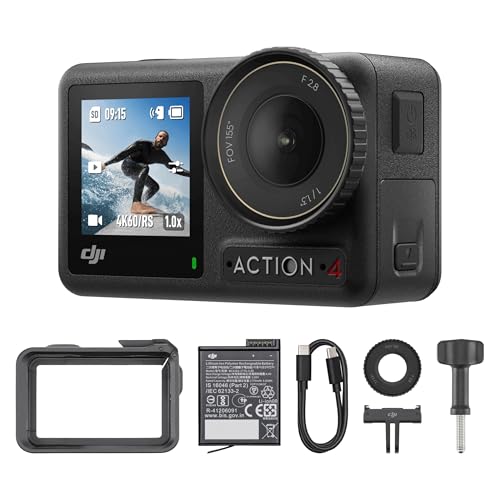
The DJI Osmo Action 4 Essential Combo is a 4K action camera that records up to 120 frames per second, captures 10-bit D-Log M colour, and is waterproof to 59 feet without a housing. The 59-foot depth limit is the deepest in this group, which makes the Action 4 the pick for deeper snorkelling and diving, where other cameras need a separate waterproof case. The 4K at 120 frames per second captures smooth slow motion of waves, jumps and fast swims, and the 10-bit D-Log M colour profile keeps more colour information for editing, which matters underwater, where reds disappear quickly with depth. The 1/1.3-inch sensor gathers more light than a smaller action-camera sensor, so the image stays cleaner in murky water and at depth. Dual touchscreens front and rear make framing and settings easy, and the magnetic quick-release mount lets the camera snap on and off a mount in seconds, which is useful when moving between a chest mount, a pole and a handheld grip. The Essential Combo includes the extras needed to start shooting, and the battery is removable for swaps. Note that an older listing for this model also exists under a different ASIN, so the Essential Combo listing should be checked before ordering. For deep-water use and slow-motion underwater video, the Osmo Action 4 is the strongest choice here.
For deep-water use, the DJI Osmo Action 4 is the strongest choice: waterproofing to 59 feet without a housing, 4K at 120 frames per second and 10-bit D-Log M colour.
AKASO Brave 7 LE 4K30 Action Camera, 20MP, Waterproof to 131ft with Case, Dual Screens, Electronic Image Stabilisation

The AKASO Brave 7 LE is a 4K action camera that records 4K video at 30 frames per second, takes 20-megapixel photos, and is waterproof to 131 feet when used with its included case. The 131-foot depth limit with the case is the deepest in this group, covering scuba diving as well as snorkelling and swimming, and the case is included, so there is no separate housing to buy. The 4K30 video is sharp enough for sharing and for editing, and the 20-megapixel photos capture stills with good detail above and below the water. Electronic image stabilisation smooths handheld shake from swimming and walking, and the dual screens help with framing a selfie shot and with changing settings. The camera uses a removable battery, so a spare can be carried for a long day on the water, and it includes mounts for helmets, bikes and poles. The image quality is a step below the leading cameras in this group, especially in low light, and the colour underwater will still need correction in editing, as with any action camera. For a buyer who wants the deepest waterproof limit with the case included and a complete set of mounts in the box, the Brave 7 LE gives the most diving depth for the least extra spending in this group.
For the deepest limit with the case included, the AKASO Brave 7 LE is the pick: waterproofing to 131 feet with its included case, 4K30 video and a complete set of mounts.
Insta360 GO 3S Action Camera, 4K Video, Waterproof to 33ft, Magnetic Mounting, FlowState Stabilisation, 128GB

The Insta360 GO 3S is a tiny 4K action camera, waterproof to 33 feet, with magnetic mounting, FlowState stabilisation and 128GB of built-in storage in this listing. The GO 3S is smaller than a thumb, which is its whole point: it clips magnetically to a hat, a chest mount or a pendant, and it can be stuck to a surfboard, a kayak or a dive mask without the weight and bulk of a normal action camera. The 4K video is sharp for a camera this small, and FlowState stabilisation keeps the footage steady while swimming or moving. The waterproofing to 33 feet covers snorkelling, swimming and shallow dives without a case, and the magnetic mounting means the camera can be moved between mounts in a second. The 128GB of built-in storage in this listing holds a long day of clips, and the camera charges in its Action Pod, which also adds a screen and extra controls. Battery life per charge is shorter than a full-size action camera, so the Pod and its charging matter on a long day, and the tiny size means the buttons and the Pod screen are small to use with wet hands. Note that several colour and storage variants of this model exist under different ASINs, so the 128GB listing should be checked before ordering. For the smallest, lightest underwater camera here, the GO 3S is in a class of its own.
For the smallest, lightest underwater camera, the Insta360 GO 3S is in a class of its own: 4K video, waterproofing to 33 feet and magnetic mounting in a thumb-sized body.
Comparison at a Glance
| Product | Video | Depth limit | Extras |
|—|—|—|—||
| GoPro HERO13 Black | 5.3K | 33ft without housing | HyperSmooth, dual screens |
| DJI Osmo Action 4 | 4K/120fps, 10-bit D-Log M | 59ft without housing | Magnetic quick release |
| AKASO Brave 7 LE | 4K30, 20MP photos | 131ft with case | Case and mounts included |
| Insta360 GO 3S | 4K | 33ft without housing | Magnetic mounting, 128GB |
Getting Good Colour in Underwater Video
The single biggest improvement in underwater video is fixing the colour. Water absorbs red light within the first few feet, so everything looks blue-green, and the deeper the camera goes, the stronger the effect. The simplest fix is to stay shallow, where more red light survives, and to shoot with the sun behind the camera, so the subject is lit by direct sunlight. A red filter on the lens restores warmth at depth, and it should be fitted before the dive, not after the footage looks blue. In editing, the white balance can be adjusted and the red channel lifted, which is why a 10-bit colour profile helps: it keeps more colour information to work with than a standard 8-bit recording. A video light also helps at close range, because it brings back the reds on a nearby reef or fish, although it does little for a distant subject.
Movement is the second thing to control. Swimming smoothly, holding the camera with both hands, and moving slowly all help the stabilisation do its job. Fast pans and sudden turns look shaky even with stabilisation, so the camera should be moved as if it were on a slow dolly rather than waved around. Short clips are better than long ones: ten seconds of steady footage of one subject is more watchable than a minute of wandering. Finally, the camera should be rinsed in fresh water after every saltwater use, and the seals should be checked before each dive, because salt and sand wear the seals that keep the water out.
Frequently Asked Questions
What is the best underwater video camera?
For the sharpest video, the GoPro HERO13 Black in this guide is the leading pick: 5.3K video, waterproofing to 33 feet without a housing and HyperSmooth stabilisation. For deeper dives, the DJI Osmo Action 4 reaches 59 feet without a housing.
How deep can an action camera go underwater?
It depends on the model. The cameras in this guide are rated from 33 feet without a housing to 131 feet with the included case, and the depth limit on the listing should always be checked before a dive.
Why does underwater video look blue?
Water absorbs red light first, so the deeper the camera goes, the more the picture shifts toward blue-green. A red filter, a video light and colour correction in editing all help restore natural colour.
Do I need a waterproof case for an action camera?
Not for shallow water, because the cameras in this guide are waterproof without a case to 33 or 59 feet. For scuba diving, a case extends the depth limit, and the AKASO Brave 7 LE in this guide includes one.
How long does an action camera battery last underwater?
Battery life is shorter in cold water, often well under an hour of continuous recording. A removable battery lets the owner carry a spare, and the camera should be charged between dives.
Conclusion
The best underwater video cameras handle water, movement and colour together. The GoPro HERO13 Black gives the sharpest video, the DJI Osmo Action 4 goes deepest without a housing, the AKASO Brave 7 LE reaches scuba depths with its included case, and the Insta360 GO 3S gives the smallest, lightest camera for the water. Stay shallow for colour, move slowly for steady footage, and rinse the camera in fresh water after every saltwater use.
Disclosure: As an Amazon Associate, stanthonyscalgary.com earns from qualifying purchases.
Related guides
More from Amazon
Programs that pair well with the guide above. Offers and eligibility are set by Amazon and may change.
Free shipping on eligible items, Prime Video and more. Eligible new members can start with a free trial.
Start a Prime free trialAudiobooks and podcasts to listen to on the go. Eligible new members can start with a free trial.
Try Audible freeAd-free music streaming. Eligible new subscribers can start with a free trial.
Try Music Unlimited freeA free business account with business pricing and bulk-buying tools for work, shop or home office.
Create a business accountAs an Amazon Associate we earn from qualifying purchases.
Write Your Review
No reviews yet. Be the first to share your experience!