
Key takeaways
- Find the best cameras for self portraits with flip screens, eye autofocus and flattering lenses. Compare four cameras built for solo portraits and pick yours.
What's inside
As an Amazon Associate I earn from qualifying purchases. This post may contain affiliate links at no extra cost to you.
Taking a portrait of yourself is a different job from photographing someone else. You are the subject and the photographer at the same time, so the camera has to do more of the work: it must show you the frame while you pose, lock focus on your eyes without help, and keep skin tones looking natural. The best cameras for self portraits make that loop simple, with a screen that turns toward you, autofocus that finds a face in a crowd of one, and controls you can reach without breaking your pose.
This guide compares four cameras for solo portrait work, from a pocket compact to interchangeable-lens bodies that grow with your skills. Every pick below has a screen you can see from the front, dependable face and eye autofocus, and a lens or sensor combination that flatters a single person in the frame. Use the quick table to shortlist, then read the buying criteria and each full model section before you decide.
At a Glance
| Product | ASIN | Best for |
|---|---|---|
| Canon EOS R50 with RF-S 18-45mm Kit Lens | B0BTTV6CT1 | All-round solo portraits |
| Sony ZV-E10 (White, Body Only) | B09BBKVMCD | Lightweight vlogging-style self portraits |
| Fujifilm X-S20 (Body Only) | B0C5PHCFRQ | Film-like colour and long solo sessions |
| Canon PowerShot G7 X Mark III (Black) | B07TKNCQZL | Pocketable portraits with no lens decisions |
How to Choose a Camera for Self Portraits
1. A screen you can see from the front
A self portrait begins with framing you cannot check over your shoulder. A vari-angle screen that flips fully forward, or a tilt screen that angles up 180 degrees, lets you see your position, your expression, and the edges of the frame while you stand in front of the lens. Touch control lets you tap your own face to set focus without hunting through buttons. All four cameras here give you a forward-facing screen.
2. Face and eye autofocus that works without a helper
When nobody stands behind the camera, autofocus becomes your second photographer. Look for face detection paired with eye autofocus, which locks onto an eye and holds it as you shift your weight or turn your head. The Canon EOS R50 and Sony ZV-E10 both carry well developed eye detection, and the Fujifilm X-S20 adds subject detection that recognises people automatically.
3. Sensor size and portrait rendering
Sensor size shapes depth of field, low-light behaviour, and background blur. APS-C sensors, found in the Canon EOS R50, Sony ZV-E10, and Fujifilm X-S20, give a clear step up from a phone in background separation and clean images indoors. The PowerShot G7 X Mark III uses a 1-inch sensor, smaller than APS-C but still larger than a phone sensor, and pairs it with a bright lens that helps in dim rooms. Colour rendering also matters: Fujifilm is known for warm, film-like colour, Canon leans toward pleasing skin tones, and Sony gives neutral files that suit editing.
4. Lens choice and focal length for flattering portraits
The Canon EOS R50 kit lens covers 18-45mm, reaching a useful portrait range at its long end. The Sony ZV-E10 and Fujifilm X-S20 are sold as body-only models here, so you choose the lens separately; a compact 35mm or 50mm equivalent prime is a strong first lens for solo portraits. The PowerShot G7 X Mark III has a fixed 24-100mm lens with a bright f/1.8 aperture at the wide end, so it covers portrait framing with no lens shopping at all.
5. Size, weight, and how you will hold it
A self portrait camera often works at arm’s length, on a small tripod, or balanced on a shelf, so weight matters more than it does for a camera that lives on a strap. The PowerShot G7 X Mark III weighs about 0.82 pounds and fits a pocket, so it is the easiest to hold out in front of you. The Sony ZV-E10 body weighs about 12.8 ounces, making it the lightest interchangeable-lens option here. The Fujifilm X-S20 weighs 491 grams with battery and card and has a deep grip that stays secure in one hand, while the Canon EOS R50 stays compact for a mirrorless body with a kit lens attached.
6. Battery life and wireless control
Solo sessions run long because every change means walking back to the camera, adjusting, and walking back to your mark. The Fujifilm X-S20 leads here with its NP-W235 battery, rated for about 750 frames in normal mode. Wireless control is the other half of the equation: a phone app that acts as a remote shutter and live viewfinder lets you trigger the camera from your mark. Keep a spare battery in your bag for long sessions.
7. Video and stills in one body
Many people who shoot self portraits also record short clips for social media, so video ability is worth weighing even in a stills-first purchase. All four cameras here record 4K video, with the Fujifilm X-S20 reaching 6.2K and the PowerShot G7 X Mark III adding Full HD at 120 frames per second for slow motion. The PowerShot G7 X Mark III has an external microphone terminal, and the mirrorless models support microphone accessories through their hot shoes and ports.
Canon EOS R50 with RF-S 18-45mm Kit Lens

Canon EOS R50 with RF-S 18-45mm Kit Lens
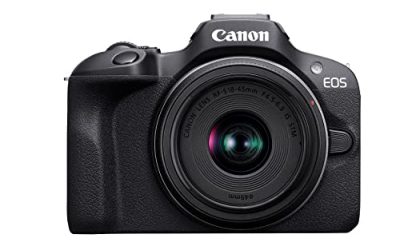
The Canon EOS R50 is the most complete first choice in this guide for someone who wants a camera that handles self portraits today and still has room to grow. Its 24.2 megapixel APS-C CMOS sensor and DIGIC X processor produce detailed files with pleasing skin tones, and the included RF-S 18-45mm f/4.5-6.3 IS STM lens covers wide shots down to a useful portrait focal length. The 3.0-inch, 1.62 million dot vari-angle touchscreen flips fully forward, so you can frame yourself, tap to focus on your own eye, and watch the composition while you pose. Dual Pixel CMOS AF II tracks faces and eyes with confidence, and continuous shooting at up to 15 frames per second lets you capture a run of expressions in one burst.
Key specifications include a 24.2 megapixel APS-C sensor, DIGIC X image processor, 4K video, a 3.0-inch vari-angle touchscreen LCD, Dual Pixel CMOS AF II, an RF-S 18-45mm f/4.5-6.3 IS STM kit lens, and a 0.39-inch OLED electronic viewfinder with about 2.36 million dots. The body stays small and light for a mirrorless camera, which helps when you hold it at arm’s length or mount it on a compact tripod.
Strengths: the flip-forward touchscreen and eye autofocus make solo framing straightforward; the kit lens means you can begin shooting portraits immediately with no extra lens purchase; Canon’s colour handling flatters skin straight from the camera; and the RF mount gives you a wide path of lenses to explore.
Limitations: the kit lens has a modest maximum aperture, so background blur is gentler than what a fast prime lens gives; the 18-45mm range means you will want a longer or faster lens if tight head-and-shoulders portraits become your main style; and battery life is ordinary for a compact mirrorless body, so a spare battery is sensible for long sessions.
Best for: beginners and returning photographers who want one camera for self portraits, family photos, and travel, with a clear upgrade path through the RF lens system.
Sony ZV-E10 (White, Body Only)

Sony ZV-E10 (White, Body Only)
The Sony ZV-E10 is built around the idea that the person in front of the lens is also the person behind it. Its 24.2 megapixel APS-C Exmor CMOS sensor and BIONZ X processor deliver clean, detailed images, while Real-Time Eye AF and real-time tracking hold focus on your eye as you move. The flip-out vari-angle LCD faces fully forward, and a single USB cable handles live streaming without extra hardware, while active image stabilisation steadies handheld clips as you walk and talk. At about 12.8 ounces for the body, it is easy to hold at arm’s length for extended stretches, and the white finish stands apart from the usual black bodies.
Key specifications include a 24.2 megapixel APS-C sensor, BIONZ X processor, 4K video oversampled from 6K, a flip-out vari-angle LCD, Real-Time Eye AF and tracking, up to 11 frames per second continuous shooting, and the Sony E-mount lens system. This listing is for the body only, so you will pair it with a lens; the Sony 16-50mm power zoom is a compact match, while a fast prime in the 35mm or 50mm range gives stronger background blur.
Strengths: the lightest interchangeable-lens body in this guide, which matters for arm’s-length shooting; eye autofocus that holds focus well for solo work; clean 4K video oversampled from 6K; and a large E-mount lens catalogue to grow into.
Limitations: it is sold as a body only, so a first-time buyer must add a lens; there is no built-in electronic viewfinder, so all framing happens on the rear screen; and the menu system takes some learning before it feels natural.
Best for: creators who split time between still self portraits and video, and who want the lightest interchangeable-lens body with strong eye autofocus.
Fujifilm X-S20 (Body Only)

The Fujifilm X-S20 suits self portrait photographers who care about colour and about staying out shooting for hours. Its 26.1 megapixel APS-C X-Trans CMOS 4 sensor and X-Processor 5 produce images with Fujifilm’s film-like colour, so portraits often need little adjustment. The 180-degree vari-angle touchscreen makes selfie-style framing simple, and Auto Subject Detection AF recognises people without manual setup. Five-axis in-body image stabilisation supports steady handheld shots at slower shutter speeds, which helps in dim indoor light. The practical advantage is endurance: the NP-W235 battery delivers about 750 frames in normal mode, more than twice the number possible with the previous model in the line, so long solo sessions do not end early.
Key specifications include a 26.1 megapixel APS-C X-Trans CMOS 4 sensor, X-Processor 5, a 3.0-inch vari-angle touchscreen, 5-axis in-body image stabilisation with up to seven stops of support, 6.2K video at 30 frames per second and 4K at 60 frames per second, a Vlog mode, and a 491 gram body with battery and card. This listing is for the body only; Fujifilm’s X-mount range includes compact primes that pair well with it for portraits.
Strengths: warm, film-like colour that flatters skin with minimal editing; the longest battery life in this guide, rated around 750 frames; strong stabilisation for handheld indoor portraits; a Vlog mode for quick adjustments while recording; and a deep, comfortable grip for one-handed holding.
Limitations: as a body-only listing it needs a lens before it can shoot, which adds a decision and an extra purchase; it is the heaviest body in this guide at 491 grams, though still compact; and its video-first feature set may be more than a stills-only photographer needs.
Best for: photographers who love Fujifilm colour, shoot long solo sessions, and want stabilisation and battery endurance that keep up with repeated takes.
Canon PowerShot G7 X Mark III (Black)

Canon PowerShot G7 X Mark III (Black)
The Canon PowerShot G7 X Mark III is the simplest route to a good self portrait in this guide, because it removes every lens decision. Its 20.1 megapixel 1.0-inch stacked CMOS sensor and DIGIC 8 processor sit behind a fixed 24-100mm f/1.8-2.8 lens with 4.2x optical zoom and optical image stabilisation, so you can frame a wide environmental portrait or a tight headshot without changing anything. The 3.0-inch touch panel LCD tilts up 180 degrees for framing from the front. It records 4K video at 30 frames per second and Full HD at 120 frames per second, supports vertical video and live streaming to YouTube, and has an external microphone terminal for cleaner audio. At 0.82 pounds it slips into a jacket pocket, so it is the camera most likely to be with you when a portrait opportunity appears.
Key specifications include a 20.1 megapixel 1.0-inch stacked CMOS sensor, DIGIC 8 image processor, a 24-100mm f/1.8-2.8 lens with 4.2x optical zoom, 4K 30p and Full HD 120p video, a 3.0-inch tilt touchscreen LCD with 180 degrees of tilt, live streaming and vertical video support, and USB charging with the PD-E1 adapter.
Strengths: no lens to choose, buy, or carry; the bright f/1.8 aperture at the wide end helps in dim light; the pocketable size and light weight suit arm’s-length shooting; and the tilt screen, vertical video, and live streaming features are built for solo creators.
Limitations: the 1-inch sensor is smaller than the APS-C sensors in the other cameras here, so background blur and low-light performance are a step behind them; the fixed lens cannot be swapped for a faster portrait prime; and the compact body means a smaller grip and shorter battery life.
Best for: travellers and social media creators who want a pocket camera that handles self portraits well with no extra gear to think about.
Comparison Table
| Feature | Canon EOS R50 | Sony ZV-E10 | Fujifilm X-S20 | Canon PowerShot G7 X Mark III |
|---|---|---|---|---|
| Sensor | 24.2 MP APS-C CMOS | 24.2 MP APS-C Exmor CMOS | 26.1 MP APS-C X-Trans CMOS 4 | 20.1 MP 1-inch stacked CMOS |
| Screen | 3.0-inch vari-angle touchscreen | Flip-out vari-angle LCD | 3.0-inch vari-angle touchscreen, 180 degrees | 3.0-inch tilt touchscreen, 180 degrees |
| Lens | RF-S 18-45mm kit lens included | Body only, E-mount | Body only, X-mount | Fixed 24-100mm f/1.8-2.8 |
| Video | 4K | 4K oversampled from 6K | 6.2K/30p, 4K/60p | 4K 30p, Full HD 120p |
| Eye autofocus | Dual Pixel CMOS AF II | Real-Time Eye AF | Auto Subject Detection AF | Face detection |
| Weight | Compact with kit lens | About 12.8 oz body | 491 g with battery and card | About 0.82 lb |
| Battery note | Standard | Standard | About 750 frames, NP-W235 | Compact body capacity |
Frequently Asked Questions
What makes a camera good for self portraits?
Three features matter most: a screen that faces forward so you can see your framing, face and eye autofocus that holds focus on you without a helper, and a lens or sensor combination that renders skin tones naturally with gentle background blur. A remote shutter or phone app is a useful bonus, because it lets you trigger the camera from your mark instead of running back and forth.
Do I need an interchangeable-lens camera for self portraits?
No. The Canon PowerShot G7 X Mark III shows that a fixed-lens compact with a bright lens and a tilt screen can handle self portraits well. An interchangeable-lens camera such as the Canon EOS R50, Sony ZV-E10, or Fujifilm X-S20 earns its place when you want stronger background blur, better low-light images, or the freedom to add a portrait prime later.
Which focal length flatters self portraits?
A focal length around 35mm to 85mm in full-frame terms usually keeps facial features in natural proportion. Very wide angles can stretch the features closest to the lens, which is unflattering at arm’s length. The kit and fixed lenses in this guide all reach into that portrait range, and a 50mm equivalent prime is a classic first portrait lens for the interchangeable-lens bodies.
How do I focus a self portrait when I am alone?
Use face and eye autofocus with a small tripod and a remote shutter or phone app. Set the camera at eye height, frame the shot with the forward-facing screen, then step to your mark and trigger the camera remotely. A short self-timer also works: set a 10-second timer, walk to your mark, and let the camera fire a burst so you have several expressions to choose from.
Conclusion
The best cameras for self portraits let you see yourself, focus on yourself, and shoot comfortably alone, and all four cameras here clear that bar in different ways. The Canon EOS R50 is the strongest all-round choice, pairing a flip-forward touchscreen and dependable eye autofocus with a kit lens that lets you begin at once. The Sony ZV-E10 is the lightest interchangeable-lens option and a natural fit for creators who mix stills with video. The Fujifilm X-S20 rewards patient shooters with film-like colour, strong stabilisation, and the longest battery life here. The Canon PowerShot G7 X Mark III keeps things simple, with a bright fixed lens and a pocketable body that is always ready. Match the camera to how you shoot — arm’s length or tripod, stills or video, one lens or a growing kit — and your solo portraits will show it.
Disclosure: As an Amazon Associate, we may earn a commission from qualifying purchases made through links in this article, at no extra cost to you.
Related guides
More from Amazon
Programs that pair well with the guide above. Offers and eligibility are set by Amazon and may change.
Free shipping on eligible items, Prime Video and more. Eligible new members can start with a free trial.
Start a Prime free trialAudiobooks and podcasts to listen to on the go. Eligible new members can start with a free trial.
Try Audible freeAd-free music streaming. Eligible new subscribers can start with a free trial.
Try Music Unlimited freeA free business account with business pricing and bulk-buying tools for work, shop or home office.
Create a business accountAs an Amazon Associate we earn from qualifying purchases.
Write Your Review
No reviews yet. Be the first to share your experience!