
Key takeaways
- One verified 8kW electric tankless heater for a bar sink: EcoSmart ECO 8 specs, 240V wiring, flow rates by inlet temperature and fit checks.
What's inside
As an Amazon Associate I earn from qualifying purchases. This post may contain affiliate links at no extra cost to you.
A bar sink has an awkward hot water problem: it sits far from the main heater, it gets used in short bursts for handwashing and rinsing, and nobody wants a bulky tank eating the cabinet that holds glassware and bottles. An 8kW electric tankless unit mounted at the point of use answers that, with more heating capacity than the small 120-volt class while staying compact. Your decision hinges on two checks: whether the panel can give it a 240-volt, 40 amp circuit, and whether incoming water temperature lets it reach a useful flow at that sink.
This article is written for home bars, basement spaces, small cafes and office kitchenettes where one bar sink needs its own supply. Strict screening shaped the shortlist: only listings stating exactly 8 kW, or 8000 watts, qualified, which ruled out the common 8.5 kW models entirely. Just one heater passed that check with a verifiable listing, the EcoSmart ECO 8, so it stands alone below rather than being padded out with near-miss products.
Quick Picks
As an Amazon Associate we earn from qualifying purchases
| Product | Best for | Key spec from title |
|---|---|---|
| EcoSmart ECO 8 | A single bar sink needing digital temperature control at the point of use | 8 kW at 240V, 8000 watts |
How to Choose
Confirm the Listing States Exactly 8 kW
Model names in this category blur together, and a heater sold as 8.5 kW is a different appliance with different wiring demands. Read the wattage line on the listing itself and look for 8 kW or 8000 watts written plainly, the wording used on the EcoSmart ECO 8 page. Titles that round numbers, hide the rating behind a series name or quote output at a non-standard voltage deserve a skip. Getting this one figure right matters because breaker size, cable gauge and expected flow all follow from it, and a substitution discovered after installation wastes an electrician visit. Screenshot the specification table before you buy, so the delivered box can be checked against it.
Plan for a 240-Volt, 40-Amp Circuit
Nothing in the 8kW class runs from a wall outlet. The ECO 8 listing specifies a 33 amp draw, one 40 amp breaker and 8 AWG wire on a 240-volt supply, so most bar installations begin with panel work rather than plumbing. Measure the cable route from panel to sink cabinet early; a long run through finished walls changes the budget more than the heater choice does. Bars in older buildings deserve extra caution, since spare double-pole space may not exist, and that single fact can end the project before it starts. Ask for the panel assessment as a separate first step, with its own quote, before committing to any heater purchase.
Match Flow to Incoming Water Temperature
An 8kW heater does not deliver one fixed flow; its output slides with the temperature of the water arriving from the street. EcoSmart lists the ECO 8 at 0.8 to 1.9 GPM depending on inlet temperature, under a 2 GPM maximum, which is generous for a bar sink yet modest in a cold-climate winter. Think about what the sink actually does: handwashing and rinsing glasses sit comfortably inside that band, while filling large pots quickly does not. Northern buyers should plan around the lower end of the range rather than the headline figure. If your supply arrives near the coldest temperatures the chart covers, expect handwashing flow rather than a fast, full stream, and choose the faucet aerator accordingly.
Check the Fit Under a Bar Counter
Bar cabinets are shallower and busier than kitchen base units, often shared with a mini fridge, bin or stored bottles. A point-of-use heater only earns its place if it mounts flat, leaves the trap reachable and keeps its connections accessible for later service. The ECO 8 activates at a low 0.25 GPM per the manufacturer sheet, which suits the short, small draws typical at a bar sink. Before ordering, open the cabinet, measure the clear wall patch you actually have, and picture where the new electrical cable will enter. Photograph the space with a tape measure visible, then compare those numbers with the listing dimensions instead of relying on memory at checkout time.
The 1 Best Options
EcoSmart ECO 8
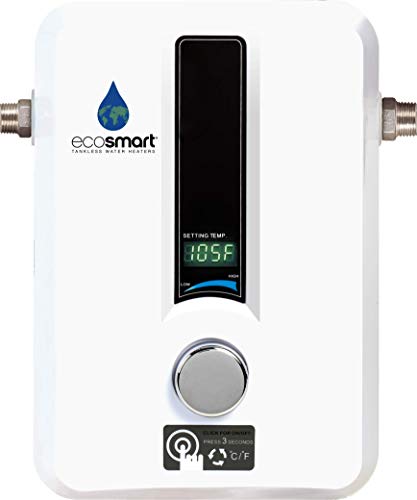
For a lone bar sink, the ECO 8 brings a step up in capacity without jumping to whole-house sizing. Its digital control adjusts in 1-degree increments across an 80 to 140 degree Fahrenheit range, letting you set handwashing water once and leave it there instead of blending at the tap every time. Flow activation at 0.25 GPM means brief rinses trigger heating reliably, a detail that matters at a bar where the tap opens for seconds at a time. The 240-volt supply is the commitment: in exchange, one sink gets hot water on demand with no tank occupying the under-counter cabinet. That combination is uncommon at exactly this rating.
Specs
- Power: 8 kW
- Wattage: 8000 watts
- Voltage: 240 volts
- Amperage draw: 33 amps
- Required breaker: 1 x 40 amp
- Required wire: 8 AWG
- Maximum flow rate: 2 GPM
- Flow rate range: 0.8 to 1.9 GPM depending on inlet water temperature
- Activation flow: 0.25 GPM
- Temperature control: digital, in 1-degree increments, 80 to 140 degrees Fahrenheit
Best for: a home bar or small cafe bar sink that needs set-and-forget temperature control at one station.
Watch out for: many similar listings are actually 8.5 kW models, so re-check the wattage line on the page before checkout.
ASIN: B00529DDUI
Which One Fits Your Situation
A Home Wet Bar Used on Weekends
Occasional use is where a tankless unit at the sink makes most sense, because water is heated only when a guest washes hands or a glass needs rinsing. The ECO 8 covers that pattern easily, and its low activation flow responds to short draws. Set the digital control once and the bar is ready whenever people gather. There is also nothing to drain, flush or relight between gatherings, which suits a room used a few evenings each month.
A Small Cafe or Taproom Bar Sink
A working bar sink cycles constantly through a shift, yet each draw stays small, which matches the ECO 8 flow band well. Digital temperature holding helps staff keep handwashing water consistent without touching the mixer all evening. Confirm local code expectations for commercial premises first, since a business setting can impose requirements a home bar never meets. Staff training is simpler too when the temperature is fixed at the unit instead of judged by hand at the mixer.
An Office Kitchenette Sink
Kitchenette sinks handle handwashing, mug rinsing and the odd filled kettle, all within a single point-of-use heater’s reach. The ECO 8 suits that mix, provided facilities can arrange the 240-volt circuit during a planned maintenance window. Its compact tankless format also frees the under-sink cupboard for cleaning supplies instead of a storage tank. Because several staff share the sink, a fixed digital setting prevents the daily readjustment that a plain mixer tap invites.
A Guest House or Pool House Bar Sink
Outbuildings often lack any sensible route back to the main home’s hot water line, making a self-contained heater at the sink the practical answer. The ECO 8 gives that single bar sink an independent supply sized for guest use. In colder regions, remember output leans toward the lower flow figure when groundwater arrives chilled in winter months. A detached building cools faster overnight, so the first draw may feel slower to warm than the same draw at midday.
Common Mistakes
- Buying an 8.5 kW model by accident; listings in this category use near-identical names, and the higher-rated unit changes the electrical specification you planned around, so read the wattage line rather than trusting the product family name or a search result headline.
- Treating the 2 GPM maximum as a promise; that figure is a ceiling, and the same listing gives 0.8 to 1.9 GPM once inlet temperature enters the picture, so a cold-climate bar sink will live near the bottom of that range during winter. Plan the faucet and aerator around the winter figure, not the brochure number.
- Skipping the panel check until installation day; a 33 amp draw on a 40 amp breaker with 8 AWG cable is a real electrical job, and discovering there is no double-pole space left in the panel strands the whole project.
- Expecting one point-of-use heater to serve the bar sink and a bathroom too; output at this size belongs to a single station, and teeing a second outlet onto the run leaves both fixtures short of temperature when they overlap.
- Setting the output temperature too high for a handwashing sink; the control reaches 140 degrees Fahrenheit, but a bar sink used by guests calls for a moderate setting, adjusted at the unit rather than corrected by mixing cold water at the tap every time.
Frequently Asked Questions
Is 8 kW enough for a bar sink?
For one bar sink, yes. Bar work means handwashing and rinsing at modest flow, and the ECO 8 delivers 0.8 to 1.9 GPM depending on inlet temperature, which covers that duty. Problems start only when the same heater is asked to feed extra outlets or fill large vessels quickly, neither of which belongs on a point-of-use unit. Keep it dedicated to that station and it stays in its comfort zone.
Why do so many similar heaters say 8.5 kW instead?
Manufacturers rate elements at different outputs, and 8.5 kW is a common rating in this size class. The difference sounds trivial but changes the appliance you are wiring for, so it is not interchangeable on paper. This roundup only accepted listings stating 8 kW or 8000 watts, which is why the field narrowed to one model. Always compare the specification table, not the headline, before treating two heaters as equivalents.
What electrical work does an 8kW heater need?
The ECO 8 listing calls for a 240-volt supply, a 33 amp draw, one 40 amp breaker and 8 AWG wire. In most buildings that means a new dedicated circuit run by an electrician, not an extension of an existing outlet. Get the panel assessed first, because available breaker space decides whether the installation is straightforward or impractical.
Can this heater replace a mini tank under the bar?
It replaces the function, not the behaviour. A mini tank holds a small reserve that arrives instantly but can run cold, while the tankless ECO 8 heats on demand for as long as the tap runs, within its flow limits. The swap also trades plumbing simplicity for electrical work, since the 240-volt circuit is the price of admission. Choose based on which trade-off your building absorbs more easily.
Related guides
More from Amazon
Programs that pair well with the guide above. Offers and eligibility are set by Amazon and may change.
Free shipping on eligible items, Prime Video and more. Eligible new members can start with a free trial.
Start a Prime free trialAudiobooks and podcasts to listen to on the go. Eligible new members can start with a free trial.
Try Audible freeAd-free music streaming. Eligible new subscribers can start with a free trial.
Try Music Unlimited freeA free business account with business pricing and bulk-buying tools for work, shop or home office.
Create a business accountAs an Amazon Associate we earn from qualifying purchases.
Write Your Review
No reviews yet. Be the first to share your experience!