
Key takeaways
- Find the best 360 video cameras for travel, action, and virtual tours, with 8K capture, stabilization, battery life, and storage compared side by side.
What's inside
As an Amazon Associate I earn from qualifying purchases. This post may contain affiliate links at no extra cost to you.
A 360 video camera records everything around it at once, so you can frame a shot after the moment has passed. That freedom changes how you shoot travel scenes, bike rides, ski runs, and walkthroughs of a home or a venue. The best 360 video cameras make that workflow simple: they stitch two fisheye views into one seamless sphere, keep the horizon level while you move, and let you reframe footage in an app or on a computer.
This guide compares four 360 video cameras listed on Amazon US, from pocketable action models to a larger-sensor DJI model and a GoPro built around reframing. Each one records true 360 video, not a wide-angle crop, and each brings a different balance of resolution, low-light ability, battery endurance, and storage.
At a Glance
| Product | ASIN | Best for |
|---|---|---|
| Insta360 X5 | B0DZCBYCNY | Low-light action and all-round 360 shooting |
| Insta360 X4 | B0CSZ8HB9W | A proven 8K 360 camera at a lower tier than the X5 |
| DJI Osmo 360 Standard Combo | B0DTTZZ6Q3 | Large-sensor image quality and built-in storage |
| GoPro MAX (2025) | B0DW6X9K7P | Simple reframing inside the GoPro app and ecosystem |
How to Choose the Best 360 Video Cameras
360 Video Resolution
Resolution matters more for 360 video than for a normal camera, because a 360 frame is spread across a full sphere and only a slice of it appears on screen at any moment. An 8K recording therefore looks much sharper after reframing than a 5.6K one. If you plan to export flat 4K clips, an 8K camera gives you the most headroom.
Sensor Size and Low-Light Behaviour
Two cameras can share the same 8K label and still produce very different footage after sunset. Larger sensors gather more light, which usually means cleaner shadows and less noise in dim rooms. The DJI Osmo 360 leads here with 1-inch sensors, while the Insta360 X5 uses 1/1.28-inch sensors with a triple-chip design aimed at low-light scenes. The X4 uses smaller 1/2-inch sensors, and the GoPro MAX is built for daylight action rather than dark interiors.
Stabilization and Horizon Lock
A 360 camera is often mounted on a helmet, a handlebar, or a selfie stick while you move, so stabilization is not a luxury. FlowState stabilization on the Insta360 models, Horizon Lock on the GoPro MAX, and the DJI stabilization system all aim to keep footage smooth when your hands shake or your bike hits a rough patch. Horizon lock keeps the horizon level even when the camera tilts, which makes mountain biking and skiing footage far easier to watch, and it removes the small bounces that make a virtual tour feel unsteady.
Battery Life and Swappable Batteries
A 360 camera drains its battery faster than a normal camera because it runs two lenses, stitches two video streams, and often powers a touchscreen at the same time. Check the recording time for the resolution you will actually use, because 8K recording uses more energy than 5.7K. The Insta360 X5 lists up to 185 minutes in endurance mode with its 2400mAh battery, the X4 lists up to 135 minutes in 5.7K30 mode with its 2290mAh battery, and the DJI Osmo 360 lists up to 100 minutes of 8K recording with its 1950mAh battery. Carrying one spare cell can matter more than a slightly longer single-charge figure, and the X5, X4, and Osmo 360 all accept a spare battery.
Waterproofing and Ruggedness
Many 360 cameras are sold as action cameras, and their waterproof depth tells you how far you can take that claim. The Insta360 X5 is waterproof to 49 feet (15 metres) without a case, the X4 to 33 feet (10 metres), the DJI Osmo 360 to 10 metres with IP68 waterproofing, and the GoPro MAX to 16 feet (5 metres). Exposed fisheye lenses scratch easily, so look for replaceable lens guards or replaceable lenses: the X5 has rugged replaceable lenses, and the X4 ships with removable lens guards. If you shoot in rain, snow, or surf, confirm the waterproof depth on the exact listing you buy, and rinse the camera with fresh water after saltwater use.
Storage, File Format, and Editing
360 video files are large, and a full day of 8K footage can fill a memory card quickly. The DJI Osmo 360 helps here with 105GB of built-in storage alongside microSD support, so you can keep shooting even when you have no spare card. The other models rely on microSD cards, so card speed and capacity deserve attention before a trip. Insta360 cameras record in MP4 and INSV formats, the Osmo 360 in MP4, and the GoPro MAX in MP4. Each brand has its own app for reframing, and the ease of that app shapes your daily workflow more than any single specification. Before you buy, confirm that your phone or computer can run the companion app and handle the file sizes your chosen resolution produces.
Insta360 X5

The Insta360 X5 is the flagship 360 camera in this guide, and its listing leads with 8K 360 video, low-light ability, and an invisible selfie stick effect that removes the stick from the frame. Its dual 1/1.28-inch sensors capture 133 percent more light than the previous model, according to the manufacturer description on the listing, and a triple AI chip design handles noise reduction in dim conditions. That combination makes the X5 the most flexible pick here for anyone who shoots from bright daylight into evening without changing cameras.
Key specs
- 8K 360 video with 72MP 360 photos
- Dual 1/1.28-inch sensors with PureVideo low-light processing
- Waterproof to 49 feet (15 metres) without a case
- 2400mAh battery, up to 185 minutes in endurance mode
- 2.5-inch touchscreen
- Replaceable lenses and built-in wind guard
- FlowState stabilization and invisible selfie stick effect
- 4K single-lens mode
Strengths
The X5 holds detail in mixed light better than any other camera in this guide, and its 8K resolution leaves the most room for reframing a flat clip from a spherical file. Replaceable lenses address the most common worry with 360 cameras, because a scratched fisheye lens no longer means a ruined camera. The wind guard helps audio on windy ridges and open roads, and the long endurance-mode battery life suits full days of travel shooting.
Limitations
The X5 records large files at its highest settings, so you will need fast microSD cards and enough storage for a long shoot. Its menu system carries many options, and new users may need a few sessions to learn where each mode lives. It is also the most feature-rich model here, so some buyers will rarely use its low-light and reframing tools if they only shoot in bright daylight.
Best for
Travel creators, action shooters, and virtual tour makers who want one 360 camera that handles daylight, dusk, water, and wind without a second device in the bag.
Insta360 X4

The Insta360 X4 remains a strong choice for buyers who want 8K 360 video without moving to the newest flagship. Its listing describes an 8K waterproof 360 action camera with 1/2-inch 48MP sensors, 72MP 360 photos, 4K single-lens video, and FlowState stabilization, and the Basic Bundle listing includes a selfie stick and a lens cap. The X4 captures 8K30 360 video and 5.7K60 video, so you can trade resolution for smoother motion when you shoot fast action.
Key specs
- 8K 360 video with 72MP 360 photos
- Dual 1/2-inch 48MP sensors
- 4K single-lens mode with up to 170-degree field of view
- Waterproof to 33 feet (10 metres) without a case
- 2290mAh battery, up to 135 minutes in 5.7K30 mode
- 2.5-inch touchscreen
- Removable lens guards
- FlowState stabilization and invisible selfie stick effect
Strengths
The X4 delivers the same 8K headline resolution and 72MP stills as the X5, which keeps it relevant for reframing and virtual tours. Its removable lens guards protect the fisheye lenses during transport and action, and the 5.7K60 mode gives smoother motion for cycling and skiing than 8K30. The Basic Bundle adds a selfie stick, the accessory most 360 shooters buy first, so the camera is ready for the invisible-stick effect from the first outing.
Limitations
Its smaller sensors gather less light than the X5 or the Osmo 360, so evening and indoor footage will show more noise. Battery life in 8K mode runs shorter than the 135-minute figure quoted for 5.7K30, so 8K shooters should carry a spare battery for a long day. The X4 also lacks the replaceable-lens design of the X5, so a badly scratched lens is a bigger problem than a scratched guard.
Best for
Buyers who want proven 8K 360 capture, a bundled selfie stick, and a lower tier than the flagship, while accepting weaker low-light footage than the X5.
DJI Osmo 360 Standard Combo
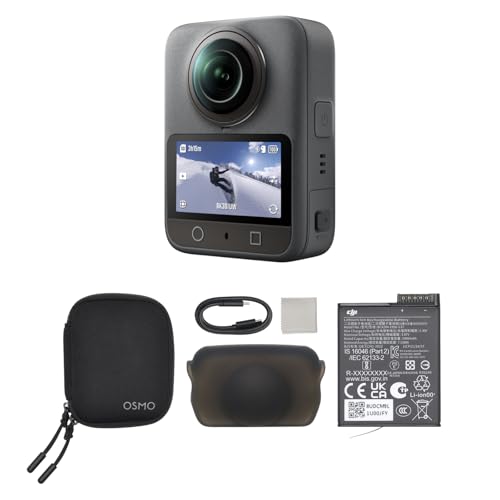
The DJI Osmo 360 takes a different route to image quality: it puts two 1-inch sensors behind its lenses and records native 8K 360 video with 120MP 360 photos. That sensor size is the largest in this guide, and it shows in the detail the camera holds in shadows and highlights. The Standard Combo listing also highlights 105GB of built-in storage, 100 minutes of 8K recording, and a 1950mAh battery, which together make the Osmo 360 a strong pick for creators who shoot long takes and edit on the move.
Key specs
- Native 8K 360 video with 120MP 360 photos
- Dual 1-inch sensors
- 105GB built-in storage plus microSD support
- 100 minutes of 8K recording
- 1950mAh battery
- 2-inch touchscreen
- Waterproof to 10 metres, IP68
- 4K/120fps single-lens mode with 170-degree field of view
- Bluetooth and Wi-Fi connectivity
- Weight: 183 grams
Strengths
The 1-inch sensors give the Osmo 360 the cleanest image in this guide in mixed and dim light, and 120MP stills hold fine detail for large prints and high-resolution virtual tours. Built-in storage removes the worry of a forgotten or full memory card, and the 183-gram body is light for a camera with sensors this large. Single-lens mode at 4K and 120 frames per second is the smoothest slow-motion option here, which suits action creators who want slow-motion clips alongside their 360 footage.
Limitations
Battery life in 8K mode is shorter than the Insta360 models, at 100 minutes, so long recording days call for a spare battery. The 2-inch screen is smaller than the 2.5-inch screens on the Insta360 cameras, which makes on-camera framing slightly harder. File sizes at 8K are large, and the 120MP stills will fill the built-in storage faster than smaller stills would, so a microSD card is still worth carrying.
Best for
Creators who put image quality first, shoot in changing light, and want built-in storage and high-resolution stills for virtual tours, property walkthroughs, and polished travel films.
GoPro MAX (2025)

The GoPro MAX (2025) is the simplest camera in this guide to understand: it records 5.6K spherical video, lets you reframe it in the GoPro Quik app, and also shoots standard Hero-style video when you do not need a full sphere. Its listing names a 1600mAh Enduro battery, a 2-inch touchscreen, Max HyperSmooth stabilization, Horizon Lock, and six microphones for 360 audio. The MAX is waterproof to 16 feet (5 metres), and its 1/4-20 mounting system opens it to a wide range of tripods, grips, and mounts.
Key specs
- 5.6K30 spherical video with 16.6MP 360 photos
- Dual lenses with in-camera stitching
- 1600mAh Enduro rechargeable battery
- 2-inch touchscreen
- Waterproof to 16 feet (5 metres)
- Max HyperSmooth stabilization with Horizon Lock
- Six microphones for 360 audio
- 1080p live streaming
- Single-lens Hero-style mode
- PowerPano mode for 270-degree panoramic stills
Strengths
The MAX has the most familiar app workflow here for anyone who already uses GoPro cameras, and reframing in Quik is straightforward for beginners. Max HyperSmooth and Horizon Lock keep footage steady and level during runs, rides, and water sports, and the six-microphone array captures directional sound that matches the reframed angle. The camera also works as a normal action camera in single-lens mode, so it can serve as a second camera for vlogging and everyday clips.
Limitations
Its 5.6K resolution leaves less detail for reframing than the 8K cameras in this guide, so a heavily cropped flat clip will look softer. The 16.6MP stills are also lower in resolution than the 72MP and 120MP stills from the other models, which matters for large virtual tour images. Battery life is shorter than the Insta360 figures, and the waterproof depth is the shallowest here, so deep-water use calls for a case.
Best for
GoPro users, beginners to 360 video, and vloggers who want easy reframing, strong stabilization, and a camera that doubles as a standard action camera.
Comparison Table
| Camera | 360 Video | 360 Photos | Sensors | Battery | Waterproof Depth | Built-in Storage |
|---|---|---|---|---|---|---|
| Insta360 X5 | 8K | 72MP | 1/1.28-inch | 2400mAh, up to 185 min endurance mode | 49 ft / 15 m | No, microSD |
| Insta360 X4 | 8K | 72MP | 1/2-inch | 2290mAh, up to 135 min in 5.7K30 | 33 ft / 10 m | No, microSD |
| DJI Osmo 360 | 8K | 120MP | 1-inch | 1950mAh, 100 min in 8K | 10 m, IP68 | 105GB plus microSD |
| GoPro MAX (2025) | 5.6K | 16.6MP | Not stated on the listing | 1600mAh Enduro | 16 ft / 5 m | No, microSD |
Frequently Asked Questions
What is the best 360 video camera for beginners?
The GoPro MAX (2025) is the easiest entry point in this guide, because its reframing workflow lives inside the familiar Quik app and its single-lens mode works like a normal action camera. The Insta360 X4 is the other beginner-friendly option, with a larger touchscreen and a bundled selfie stick in the Basic Bundle listing.
Do I need 8K 360 video, or is 5.6K enough?
It depends on how you will watch the finished video. An 8K sphere gives you more detail after reframing, because only part of the sphere appears on screen at once. If you export flat 4K clips or show footage on a large screen, 8K from the X5, X4, or Osmo 360 is worth having. If your videos will be watched mainly on a phone, or you want smaller files and faster editing, the 5.6K GoPro MAX can still produce clean results.
Can a 360 video camera replace a normal action camera?
Yes, for many shooters. All four cameras in this guide have a single-lens mode that records ordinary wide-angle video, and the Osmo 360 reaches 4K at 120 frames per second in that mode. A 360 camera is larger than a compact action camera, and its fisheye lenses need more care, but one device can cover immersive footage, vlogging, and standard action clips on the same trip.
How long can I record 360 video on one battery?
Recording time depends on resolution, temperature, and screen use. The listings quoted here give up to 185 minutes for the X5 in endurance mode, up to 135 minutes for the X4 in 5.7K30 mode, and 100 minutes for the Osmo 360 in 8K, while the GoPro MAX listing names a 1600mAh Enduro battery without a quoted minute figure. For a long day, carry a spare battery and a fast microSD card, and keep the screen brightness low when you are not framing a shot.
Conclusion
The best 360 video cameras in this guide cover four different ways to shoot a full sphere. The Insta360 X5 is the most capable all-round choice, with 8K capture, strong low-light behaviour, replaceable lenses, and the longest endurance-mode battery life here. The Insta360 X4 keeps 8K capture and 72MP stills at a lower tier, with a bundled selfie stick and a proven design. The DJI Osmo 360 leads on image quality, with 1-inch sensors, 120MP stills, and 105GB of built-in storage. The GoPro MAX (2025) trades resolution for simplicity, with easy reframing, Max HyperSmooth stabilization, and a familiar app for anyone already in the GoPro world.
Match the camera to your main use: the X5 for mixed light and long days, the X4 for a proven 8K camera with a bundle, the Osmo 360 for the highest image quality and stills, and the MAX for the simplest path from a 360 recording to a finished clip.
Disclosure: As an Amazon Associate, we may earn a commission from qualifying purchases made through links in this article, at no extra cost to you.
Related guides
More from Amazon
Programs that pair well with the guide above. Offers and eligibility are set by Amazon and may change.
Free shipping on eligible items, Prime Video and more. Eligible new members can start with a free trial.
Start a Prime free trialAudiobooks and podcasts to listen to on the go. Eligible new members can start with a free trial.
Try Audible freeAd-free music streaming. Eligible new subscribers can start with a free trial.
Try Music Unlimited freeA free business account with business pricing and bulk-buying tools for work, shop or home office.
Create a business accountAs an Amazon Associate we earn from qualifying purchases.
Write Your Review
No reviews yet. Be the first to share your experience!