
Key takeaways
- Find the best vlogger cameras for YouTube, travel, and daily content. Compare Sony ZV-1, Canon PowerShot V10, and DJI Osmo Pocket 3 for creators on the move.
As an Amazon Associate I earn from qualifying purchases. This post may contain affiliate links at no extra cost to you.
The best vlogger cameras are built for one job: filming yourself, well, anywhere. A vlogger camera needs a flip screen so you can see yourself, autofocus that locks onto your face and stays there, a microphone that captures clear voice audio, and a body light enough to hold at arm’s length for minutes at a time. A regular camera can do some of these things, but a vlogger camera does all of them by design.
This guide covers four cameras that are genuinely built for vlogging, all listed on Amazon US. The Sony ZV-1 is the classic vlogging camera, the Canon PowerShot V10 is the simplest, and the DJI Osmo Pocket 3 is the most portable. Between them, they cover every kind of creator, from a YouTuber filming in a studio to a traveler filming on a mountain trail.
What to Look For
A flip screen you can see while filming. This is non-negotiable for vlogging. A fully articulating screen that flips to the front lets you check your framing, your focus, and your background before you record. A screen that only tilts up is a compromise, and a fixed screen rules a camera out for self-filming.
Autofocus that finds your face and your eyes. Vlogging autofocus must lock onto your face quickly and hold it while you move, gesture, and walk. Eye detection is the key feature: it keeps your eyes sharp even when you move toward or away from the camera. A camera that hunts for focus in the middle of a sentence ruins a take.
Audio quality and a microphone input. Viewers forgive average video, but they abandon a video with bad audio. A good built-in microphone is essential, and a microphone input or a hot shoe for an external microphone lets you upgrade later. Wind noise reduction helps outdoors.
Image quality in real light. A larger sensor produces cleaner footage in dim rooms and smoother background blur. A one-inch sensor, like the ZV-1’s, is a big step up from a phone, while smaller sensors need more light. Check how the camera performs indoors, not just in sunlight.
Stabilization for walking shots. If you film while walking, stabilization keeps the footage smooth instead of shaky. In-body or lens stabilization helps, and some cameras add digital stabilization on top. A gimbal, built in or attached, is the gold standard for moving footage.
Size and weight. You will hold this camera at arm’s length, carry it all day, and mount it on a small tripod. A light camera is a camera you will actually use. Check the weight with a lens attached, not just the body alone.
Battery life and charging. Vlogging drains batteries fast, especially with the screen flipped out and the microphone running. USB charging lets you top up from a power bank between takes, which is far more practical than carrying a separate charger.
Connectivity for sharing. Wi-Fi and Bluetooth let you send clips to your phone for quick editing and posting. This matters if you publish daily and need a fast workflow from camera to social media.
Top Picks
1. Sony ZV-1 Vlogging Camera
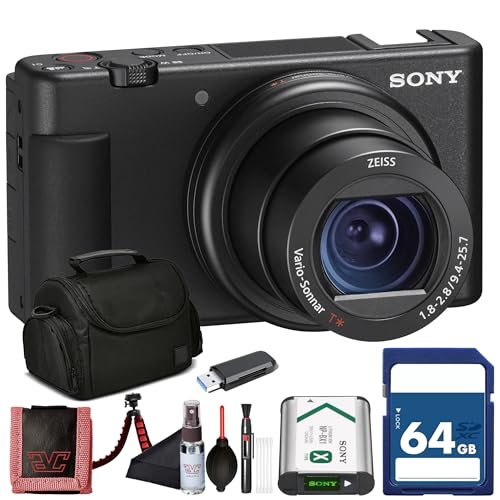
The Sony ZV-1 is the camera that defined modern vlogging, and it remains the benchmark. Its one-inch sensor is much larger than a phone sensor, which gives you cleaner low-light footage and a pleasing background blur that makes you stand out from your surroundings. Its autofocus uses Sony’s eye detection, which locks onto your eyes and tracks them as you move, so you stay sharp even while walking and talking.
The fully articulating screen flips to the front for self-framing, and the camera’s built-in microphone is directional, capturing your voice clearly while reducing background noise. A dedicated background defocus button blurs the background instantly, and a product showcase mode shifts focus to an object you hold up, then back to your face, which is perfect for creators who demonstrate products on camera.
The ZV-1 is compact and light enough to hold at arm’s length, and it charges over USB, so a power bank keeps it going on a long shoot. Its battery life is modest, which is the main weakness, so carry a spare battery or a power bank. For a creator who wants the best all-round vlogging camera, the ZV-1 is the standard against which the others are measured.
2. Sony ZV-1 with Vlogger Accessory Kit

The Sony ZV-1 with Vlogger Accessory Kit is the same camera as the pick above, bundled with the accessories a new vlogger needs most. The kit includes a shooting grip that doubles as a mini tripod, which steadies handheld shots and lets you set the camera down for a static take, and a wind screen for the microphone that reduces wind noise outdoors.
The grip is the most useful part of the bundle. It makes the camera far more comfortable to hold at arm’s length, and its tripod legs let you place the camera on a table for a sit-down video. The wind screen is a simple foam cover, but it makes a noticeable difference when filming outside on a breezy day.
If you already own a grip and a wind screen, buy the camera alone. If you are starting from scratch, the bundle saves you from buying accessories separately and gets you filming properly on day one. The camera itself is identical, so this pick is about convenience and value rather than a different shooting experience.
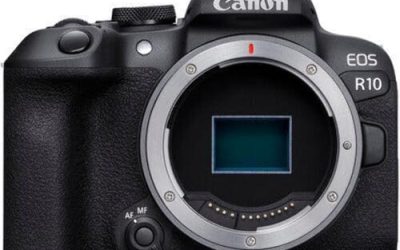
3. Canon PowerShot V10 Vlogging Camera

The Canon PowerShot V10 is the simplest vlogging camera in this guide, and its simplicity is its strength. It is a small, upright camera with a built-in stand, a flip screen, and a wide-angle lens, designed to be picked up and used with no learning curve. You press record, you talk, and the camera handles focus and exposure.
The V10’s wide lens captures you and your surroundings without needing to hold the camera far away, which is useful in small rooms and crowded streets. Its autofocus tracks faces, its built-in microphones capture clear stereo audio, and its built-in stand lets you set it on a table for a hands-free take. It charges over USB-C, and it can double as a webcam for live streaming.
The V10’s sensor is smaller than the ZV-1’s, so its low-light performance and background blur are more modest. It has no interchangeable lens and no microphone input, so it is not a camera you grow into. But for a beginner, a traveler, or a creator who wants the easiest possible vlogging camera, the V10’s simplicity is a genuine advantage.
4. DJI Osmo Pocket 3 Creator Camera

The DJI Osmo Pocket 3 is the most portable camera in this guide, and the most technically impressive. It is a tiny camera on a three-axis gimbal, which means its footage is smooth even when you walk, run, or climb stairs. The gimbal does what no handheld camera can: it removes shake mechanically, so your footage looks like it was shot on a stabilizer.
Its one-inch sensor matches the ZV-1 for image quality, producing clean low-light footage and a pleasing background blur. The two-inch touchscreen rotates to switch between horizontal and vertical filming, which is perfect for creators who publish to both YouTube and short-form platforms. ActiveTrack follows a subject automatically, keeping you centered in the frame as you move.
The Pocket 3 fits in a pocket, charges over USB-C, and is ready to film in seconds. Its small screen is the main compromise, and its microphone is good but benefits from an external mic for serious work. For a traveler, a daily vlogger, or a creator who films while moving, the Pocket 3’s gimbal and pocket size make it the most capable camera here.
Comparison at a Glance
| Camera | Sensor | Screen | Stabilization | Best For |
|---|---|---|---|---|
| Sony ZV-1 | 1-inch | Fully articulating | Digital and lens | Best all-round vlogging |
| Sony ZV-1 Accessory Kit | 1-inch | Fully articulating | Digital and lens | Ready-to-shoot bundle |
| Canon PowerShot V10 | 1-inch type | Flip-up | Digital | Simplest vlogging camera |
| DJI Osmo Pocket 3 | 1-inch | Rotating touchscreen | 3-axis gimbal | Smooth footage on the move |
FAQ
Do I need a vlogging camera, or is my phone enough?
A phone is enough to start, and many creators begin there. A vlogging camera has a larger sensor for better low-light footage, a flip screen, better audio, and a dedicated tool that does not interrupt your filming with notifications. Upgrade when your phone limits your content, not before.
What is the best vlogging camera for beginners?
The Canon PowerShot V10 is the easiest to use, with no settings to learn. The Sony ZV-1 is the best camera to grow with, because its image quality and autofocus reward you as your skills improve. Choose the V10 for simplicity and the ZV-1 for quality.
How important is a microphone input?
Very important if you film outdoors or in noisy places. A camera’s built-in microphone is adequate indoors, but wind and crowd noise ruin outdoor audio. A microphone input lets you add a directional or wireless microphone, which is the single biggest upgrade to a vlog’s quality.
Can I use a vlogging camera as a webcam?
Yes. The Sony ZV-1, Canon V10, and DJI Pocket 3 can all work as webcams for live streaming and video calls, usually over USB. This makes them dual-purpose tools for creators who also stream.
How do I keep my footage stable while walking?
Use a camera with a gimbal, like the Pocket 3, or a grip with stabilization, and walk with bent knees, taking smooth steps. Digital stabilization helps, but a mechanical gimbal is far more effective than software alone.
Conclusion
The best vlogger cameras make filming yourself easy, and the right one depends on how you create. The Sony ZV-1 is the best all-round vlogging camera, and its accessory kit is the fastest way to start properly. The Canon PowerShot V10 is the simplest camera here, perfect for beginners and travelers. The DJI Osmo Pocket 3 is the most portable and the smoothest, thanks to its gimbal. Pick the camera that matches your style, keep it charged, and start filming: the best vlog is the one you actually make.
Disclosure: As an Amazon Associate, stanthonyscalgary.com earns from qualifying purchases.
Related guides
More from Amazon
Programs that pair well with the guide above. Offers and eligibility are set by Amazon and may change.
Free shipping on eligible items, Prime Video and more. Eligible new members can start with a free trial.
Start a Prime free trialAudiobooks and podcasts to listen to on the go. Eligible new members can start with a free trial.
Try Audible freeAd-free music streaming. Eligible new subscribers can start with a free trial.
Try Music Unlimited freeA free business account with business pricing and bulk-buying tools for work, shop or home office.
Create a business accountAs an Amazon Associate we earn from qualifying purchases.
Write Your Review
No reviews yet. Be the first to share your experience!